|
|
.PNG) |
Air Interface:
In wireless communications, the air interface is the radio frequency
(RF) part of the network that transmits signals between base stations
and end-user equipment. The air interface is defined by specifications
for a specific format such as GSM, cdma2000, GPRS, or W-CDMA
|
|
Advanced
Mobile Phone Service (AMPS): The original analogue “cellular”
service transmission standard first deployed in the United States, still
used as a default standard for cellular systems in the U.S,
Canada and parts of central and
south America. |
|
.JPG) |
Absolute Radio Frequency Channel Number (ARFCN): A unique number given to each radio channel in GSM. The ARFCN can be used to calculate the exact frequency of the radio channel. Within the GSM900 band ARFCN 1 to 124 are used. In the GSM1800 band ARFCN 512 to 885 are used. The ARFCNs used in GSM1900 overlap with the ARFCNs used in GSM1800. In GSM1900, ARFCN 512 to 810 are used. A multiband mobile phone will interpret ARFCN numbers 512 to 810 as either GSM1800 or GSM1900 frequencies. The mobile phone will need an additional parameter BAND_INDICATOR to make the correct interpretation. |
 |
Advanced Research Projects Agency Network (Arpanet): The first packet-switched network in the world. The Arpanet connected universities and research centres in the U.S. Arpanet is the predecessor of the Internet. It was developed in 1969 by ARPA, a project agency of the Department of Defense. ARPA was set up by the American President Eisenhower. Initially, ARPANET connected a group of scientists at four universities, allowing them to work together. In 1980, Arpanet connected over 400 host computers at universities, governmental organisations, military installations, private companies and non-profit organisations. Other networks were built that were based on the same technology. Eventually, the name ARPANET was dropped and replaced by the simpler name Internet. A network of computer networks. |
 |
AfriNIC (African Network Information Centre): A non profit organization responsible for the administration and registration of IP-adresses in the African region. AfriNIC is one of the five Regional Internet Registry (RIR) organizations. |
|
Analogue:
The traditional method of adapting radio signals so they can carry
information. AM (Amplitude Modulation) and FM (Frequency Modulation) are
the two most common analog systems.
Analog has largely been replaced by digital technologies, which
are more secure, more efficient and provide better quality.
|
|
 |
Asymmetric Digital Subscriber Line
(ADSL): A communications technology that enables
high-speed data to be sent simultaneously with voice over the existing
telephone line. The data flow is asymmetric which means that the speed
of the downstream link from the network to the user is substantially
higher than the upstream link from the customer into the network. The downstream speed is maximum 8 Mbit/s. ADSL is the most predominant technology for high speed Internet access around the world. ADSL is specified in ITU-T Recommendation G.992.1. ITU Recommendation G.992.3 specifies ADSL2 which provides slightly better performance than G.992.1. ITU Recommendation G.992.5 specifies ADSL2Plus, which provides twice the bandwidth so that bit rates as high as 20 Mb/s downstream can be achieved on relatively short lines. |
.JPG) |
Asynchronous Transfer Mode (ATM):
A packet based switching and multiplexing technology.
ATM is connection-oriented. In ATM, the information is packed into
fixed-size cells of relatively short length. Each cell has a length of
53 bytes (octets) of which 48 can be used for user information. These
cells are identified and switched throughout the network by means of a
label in the header. The term asynchronous refers to the fact that cells
allocated to the same connection do not necessarily have to be
transmitted in a regular interval. Cells are filled according to the
actual demand. In ATM it is possible to allocate capacity on demand. The header of an ATM cells contains a virtual path identifier (VPI), a virtual channel identifier (VCI) and an error detection field. Error detection is confided to the header. The user has to take care of its own error detection. The VPI and VCI define the fixed route all cells of a session take when transmitted through the network. |
.PNG) |
|
.PNG) |
Base Station:
Base Station Base station (BS), also called cell site, is the local
cellular tower and radio antenna (including the radios, controller,
switch interconnect, etc.) that handles communication with mobile users
in a particular area or cell. A cellular network is made up of many cell
sites or base stations, all connected back to the switch via landline or
microwave links. |
.JPG) |
Base Station Controller (BSC): Part of a GSM network used to control of and supervise a number of Base Transceiver Stations (BTS). The BSC is responsible for the allocation of radio resources to a mobile call and for the handovers that are made between base stations under his control. Other handovers are under control of the MSC. |
| Base Transceiver Station (BTS): A term used to denote a base station in GSM terminology. A BTS consists of an antenna and the radio equipment necessary to communicate by radio with a Mobile Station (MS). Each BTS covers a defined area, known as a cell. A BTS is under control of a BSC, which is in turn under control of a MSC (Mobile Switching Centre). | |
 |
Bluetooth:
The name for a technological standard (a communications protocol)
that enables mobile devices equipped with a special chip to send and
receive information wirelessly.
Using Bluetooth, electronic devices such as desktop computers,
wireless phones, electronic organizers and printers can communicate over
short-ranges using the 2.4 GHz spectrum band. |
.PNG) |
Broadband:
A transmission facility having a bandwidth (capacity) sufficient
to carry multiple voice, video or data channels simultaneously.
Broadband is generally equated with the delivery of increased
speeds and advanced capabilities, including access to the Internet and
related services. The threshold hold speed for broadband is usually
determined by the telecommunication regulator and may therefore
differ from country to country. |
.JPG) |
Broadcast Control Channel (BCCH): A logical broadcast channel used by the basestation in a GSM network to send information about the identity of the network. This information is used by a mobile station to get access to the network. This information includes the Mobile Network Code (MNC), the Location Area Code (LAC) and a list of frequencies used by the neighbouring cells (BA: BCCH Allocation List). |
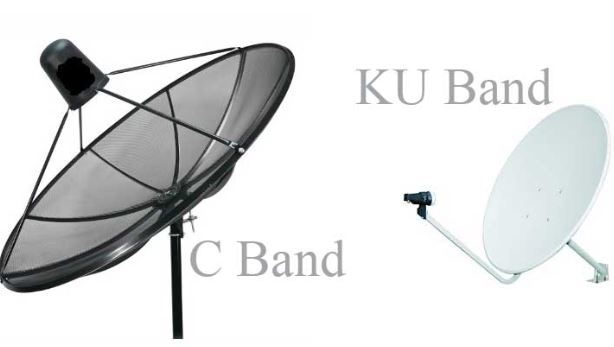 |
C-band: The a portion of the microwave band ranging
from 4-8 GHz, and a wavelength of around 5 cm. The C-band is commonly
used for satellite communications. The bands available for satellite communications are 3.4-4.2 GHz (space-to-Earth) and 5.925-6.725 GHz (Earth-to-space). More specifically, the bands 3.7-4.2 GHz (space-to-Earth) and 5.925-6.425 GHz (Earth-to-space) are usually referred to as "Standard" C-band and the bands 3.4-3.7 GHz (space-to-Earth) and 6.425-6.725 GHz (Earth-to-space) are usually referred to as "Extended" C-band. The band is further used for radar, including weather radar, and Radio LAN in the 5 GHz range. |
.PNG) |
CDMA (Code Division Multiple Access):
An air interface technology that was developed by the |
.JPG) |
CDMAOne (IS-95):
cdmaOne was developed by the U.S. based company Qualcomm. It is deployed
in the United States and parts of Asia, e.g. South Korea. The first
version, IS-95A, has very limited abilities for data communications. The
maximum data rate is 14.4 kbit/s. IS-95B extended the data communication
abilities to packet switching with a maximum data rate of in theory 115
kbit/s, and in practice of around 64 kbit/s. cdmaOne makes use of radio channels with a bandwidth of 1.25 MHz in the 850 and 1900 MHz bands. cdmaOne is a 2nd generation technology. The evolution continues with the 3rd generation standard CDMA2000. |
.JPG) |
CDMA2000: A 3rd generation mobile communications standard which is a member of the IMT-2000 "family" of standards. CDMA2000 is based on the 2nd generation cdmaOne/IS-95 standard. |
.JPG) |
Cell Broadcast (CB):
Also known as Short Message Service - Cell Broadcast (SMS-CB), is
a one-to many geographically focused messaging service, whereas the Short
Message Service - Point to Point (SMS-PP) is a one-to-one and
one-to-a-few service. Cell Broadcast is designed for simultaneous
delivery of messages to multiple users in a specified area. CB is a
mobile technology feature defined by the ETSI’s GSM committee and is
part of the GSM standard. Cell Broadcast messaging is also supported by
UMTS, as defined by 3GPP. |
.PNG) |
Cell: A geographic area that is covered by a single base station in a cellular network. A network for wireless communications is comprised of a large number of base stations to efficiently use radio spectrum to cover the service area. Geographically separated frequencies may be reused many times.
|
| Cellular network: A mobile network that provides services by using a large number of base stations with limited power, each covering only a limited area. This area is called a cell. The limited power makes it possible to re-use the same frequency a few cells away from the base station without causing interference. In this way a geographic large area can be covered with only a limited set of frequencies | |
 |
Channel:
Refers to a one-way telecommunications
link or transmission medium through which information or signal is
transmitted from a sender (or transmitter) to a receiver. They may be
either physical or logical depending on the application. A Radio
Frequency (RF) channel is a physical channel, whereas control and
traffic channels within the RF channel would be considered logical
channels.
|
.JPG) |
Circuit Switched Data(CSD):
One technological approach used for the exchange of data. A
circuit connection is made that is exclusively reserved for the
individual’s use. This can be inefficient, as many communications do not
require a dedicated communications channel, but only brief connectivity,
for the transmission of short messages. |
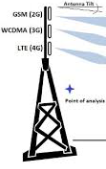 |
Co-location:
Placement of multiple antennas at a common site.
Some companies act as brokers or cell site managers, arranging
cell sites and coordinating many carriers' antennas at a single cell
site. |
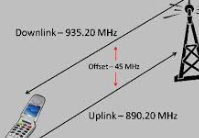 |
Downlink:
The transmission path from the base station down to the mobile station. |
|
Dual Band:
A wireless handset that works on more than one spectrum
frequency, e.g., in the 900 MHz frequency and 1800 MHz frequency bands. |
|
|
Dual Mode:
A wireless handset that works on both analog and digital networks. |
|
|
|
|
|
Enhanced Messaging Service ( |
|
|
Evolution Data Only (EVDO):
A high-speed network protocol used for wireless Internet data
communications. The EVDO protocol supports asymmetric communications,
allocating a majority of this bandwidth to downloads. EVDO is based on
the 1xRTT standard, providing data transmission speeds wirelessly up to
3.1Mbps. It is for always-on mobile packet data and voice for
GPRS-enabled cellular phones, networks and handheld devices. |
|
.PNG) |
Frequency Division Multiplexing(FDM):
Frequency-division multiplexing is a method in which numerous signals
are combined for transmission on a single communications channel. Each
signal is assigned a different frequency (subchannel) within the main
channel. |
.PNG) |
Fixed Wireless:
The over-the-air transmission of information to and from systems
and end-user equipment that are stationary, rather than mobile.
Operators of fixed wireless networks potentially can offer broadband
services without having to lay expensive cable systems or deal with the
complexities of mobility management.
|
 |
Global System for |
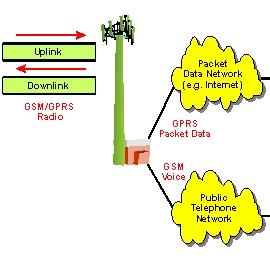 |
General Packet Radio Service (GPRS): A technology for the support of packet switching traffic in a GSM network. GPRS enables high-speed wireless Internet and other data communications in GSM. The data speed of GPRS is more than four times greater speed than conventional GSM systems. Using a packet data service, subscribers are always connected and always on line so services will be easy and quick to access. In GPRS, the GSM time slots are dynamically allocated to various users by the packet control unit (PCU) according to their instantaneous demand. Users can alternately transmit data in the same slot. All data is packetized and send instantaneously through available resources. This gives the user the experience of being permanently linked to the network
|
.PNG) |
Global Positioning System (GPS):
A worldwide satellite navigational system, made up of 24 satellites
orbiting the earth and their receivers on the earth’s surface.
The |
|
Global
System for Mobile communications (GSM): A wireless
telecommunications standard for digital cellular services. The original
standard was optimized for voice communications and provided only
circuit-switched data connections at a bit rate of 9.6 kbps and a short
messages service (SMS). Later enhancements made higher bit rates and
packet switched data possible. GSM is based on TDMA technology. Although the roots of GSM are European, GSM is nowadays the biggest standard used for the 2nd generation of mobile communications. The success of GSM made roaming in big parts of the world possible. |
|
| GSM EDGE Radio Access Network (GERAN): A radio access network architecture, based on GSM/EDGE radio access technologies. The GERAN is fully harmonised with the UMTS Terrestrial Radio Access Network (UTRAN) through a common connectivity to the UMTS core network. This makes it possible to build a combined network for GSM/GPRS and UMTS. | |
|
GSM 1800:
also known as |
|
|
GSM 1900:
also known as |
|
|
GSM 900:
or just GSM, is the world's most widely used digital network -- now
operating in over 100 countries around the world, particularly in |
|
| Handover: A process by which a mobile telephone call is transferred from one base station to another as the subscriber passes the boundary of a cell. | |
.PNG) |
Handoff:
The process when a wireless network automatically switches a mobile call
to an adjacent cell site. |
.PNG) |
Hot Spot:
An area, such as a hotel, restaurant or airport, that offers Wi-Fi
access, either free or for a fee. |
|
HSCSD (High Speed Circuit Switched Data): High Speed Circuit Switched Data (HSCSD): An enhancement in the data rate of circuit switched data in a GSM network. HSCSD uses two techniques to increase the data rate. First, HSCSD makes it possible to use more than one time slot. GSM uses time division multiple access (TDMA). Each radio channel is divided in eight time slots. Each time slot is allocated to a different user. This makes it possible to serve eight customers on one radio channel. HSCSD makes it possible to allocate more than one time slot to a user. The second technique used by HSCSD is that the error correction can be adapted to the quality of the radio channel. A standard slot can carry 9.6 kbps. HSCSD makes it possible to increase this to 14.4 kbps. the quality of the radio channel must be good enough to do so. The maximum data rate of a HSCSD configuration with 14.4-kbps channel coding is 115.2 kbps, if all eight time slots are allocated to the same user. In practice, is the number of time slots allocated to a user limited to three, limiting the data rate to 43.2 kbps. Another point is that the core network is based on circuit switched data with data channels of 64 kbps.
The main benefit of HSCSD compared to other data enhancements introduced
later is that it is an inexpensive way to implement higher data rates in
GSM networks. There modifications to be made are relatively small. Users
need to have a new terminal that supports HSCSD.
|
|
|
High Speed Downlink Packet Access
(HSDPA): An enhancement of the UMTS radio-interface to
make higher data rates possible. HSDPA introduces a high speed downlink
shared channel (HS-DSCH). This high speed channel is shared among the
users. The "theoretical" peak data rate is in the order of 14 Mbps.
HSDPA provides average data throughput speeds of 550-1100 kbps to the user. The delay within the network (latency) is also lower. HSDPA can be implemented in the standard 5 MHz channels available for UMTS. HSDPA requires a software and hardware modification of the base stations (Node B) as well as a software upgrade of the Radio Network controller (RNC). The user will require a new terminal. |
|
| High Speed Packet Access (HSPA): A generic term to refer to improvements in the UMTS Radio Interface. HSPA refers to both improvements made in the downlink, often referred to as High Speed Downlink Packet Access (HSDPA) and to improvements made in the uplink, often referred to as High Speed Uplink Packet Access (HSUPA). Only the radio access network, notably the base stations (Node B) has to be modified to implement HSPA. | |
| High Speed Uplink Packet Access (HSUPA): An enhancement of the UMTS radio-interface to make higher data rates possible in the uplink. To do so, HSUPA introduces an enhanced dedicated channel (E-DCH). In UMTS Release 6, HSUPA is referred to as E-DCH. HSUPA improves the coverage, the throughput as well as the delay of the uplink dedicated transport channels. HSUPA is the counterpart of HSDPA, which improves the data rate on the downlink. | |
 |
Home Location Register (HLR): The central
database in a GSM or CDMA network contains details of all mobile phone
subscribers authorized to use the GSM core network. HLR store details of
every SIM card issued by the mobile phone operator. Each SIM has a
unique identifier called an International Mobile Subscriber Identity
(IMSI) which is the primary key to each HLR record. The HLR data is
stored for as long as a subscriber remains with the mobile phone
operator. Data stored in the HLR against an IMSI record include: (a) GSM services that the subscriber is allowed to access; (b) GPRS settings to allow the subscriber to access packet services; (c) Current location of subscriber (VLR and serving GPRS support node/SGSN); and (d) Call divert settings applicable for each associated MSISDN. |
|
Interconnection: Connecting one wireless network to another, such as linking a
wireless carrier's network with a local telephone company’s network. |
|
 |
International Mobile Equipment Identity
(IMEI): A number unique to
every GSM and UMTS mobile phone. It is usually found printed on the
phone underneath the battery and can also be found by dialing the
sequence *#06# into the phone. The IMEI number is used by the GSM
network to identify valid devices and therefore can be used to stop a
stolen phone from accessing the network. For example, if a mobile phone
is stolen, the owner can call his or her network provider and instruct
them to "ban" the phone using its IMEI number. This renders the phone
useless, regardless of whether the phone's |
|
Interoperability: The ability of a network to coordinate and communicate with other
networks, such as two systems based on different protocols or
technologies. |
|
.PNG) |
Local Area Network ( |
 |
Long Term Evolution (LTE), sometimes also
referred to as 3G LTE or Super-3G:
A 3GPP radio technology evolution architecture. Its full name is
UTRA-UTRAN Long Term Evolution (LTE) and 3GPP System. |
.PNG) |
Mobile Switching Centre ( |
|
Mobile Telephone Switching Office (MTSO):
The central computer that connects wireless phone calls to the public
telephone network. The MTSO controls the series of operations required
to complete wireless calls, including verifying calls, billing and
antenna handoffs. |
|
|
Mobile Virtual Network Operator (MVNO): A company that buys network capacity from a mobile network operator in order to offer its own branded mobile subscriptions and value-added services to customers. Example of MVNO in Kenya is EQUITEL |
|
|
Multimedia Messaging Service ( |
|
|
Number Portability:
The ability of a customer to retain their telephone number when
changing service providers in a specific area, whether changing from one
wireless company to another, one wireline company to another, or between
wirelesss and wireline companies. |
|
|
Orthogonal Frequency Division
Multiplexing (OFDM): A system
for the transmission of digital message elements spread over multiple
channels within a frequency band, in order to achieve greater throughput
while minimizing interference and signal degradation through the use of
multiple antennas. |
|
.PNG) |
Packet Data:
Information that is reduced into digital pieces or ‘packets’, so it can
travel more efficiently across networks, including radio airwaves and
wireless networks. |
|
Packet Switched Data ( |
|
.PNG) |
Packet:
A piece of data sent over a packet-switching network, such as the
Internet. A packet includes
not just the data comprising the message but also address information
about its origination and destination. |
|
Personal Communications Services ( |
|
.PNG) |
Personal Digital Assistant (PDA):
A portable computing device capable of transmitting data. These devices
offer services such as paging, data messaging, email, computing, faxes,
date books and other information management capabilities. |
|
Personal Identification Number ( |
|
|
Protocol:
A standard set of definitions governing how communications are
formatted in order to permit their transmission across networks and
between devices. |
|
.PNG) |
Public Switched Telephone Network (PSTN):
The network of the world's public circuit-switched telephone networks,
providing commercial telephony services. Originally as a network of
fixed-line analogue telephone systems, the PSTN is now almost entirely
digital and includes mobile as well as fixed telephones. |
|
Roaming:
A facility including protocols that
allows users to continue to make and receive calls when operating in
another carrier’s service coverage area. |
|
.PNG) |
Short Message Service Centre ( |
|
Short Messaging Service (SMS):
The service that allows the transmission of short text messages among
mobile devices such as cell phones, fax machines and BlackBerry devices.
SMS was originally designed as part of GSM, but is now available on a
wide range of networks, including 3G networks. There are two forms of
SMS: Short Message Service - Point-to-Point (SMS-PP) and Short Message
Service - Cell Broadcast (SMS-CB). The message length is 140 bytes.
Larger contents (known as long SMS or concatenated SMS) can be sent
segmented over multiple messages, in which case each message will start
with a user data header (UDH) containing segmentation information. |
|
 |
Smart Antenna: A wireless antenna with technology that focuses its signal in a
specific direction. Wireless networks use smart antennas to reduce the
number of dropped calls, and to improve call quality and channel
capacity. |
|
Smart Phone:
Wireless phone with advanced data features and often with a keyboard.
What makes the phone "smart" is its ability to manage and transmit data
in addition to voice calls. |
|
|
Spectrum Allocation:
Process whereby the telecommunication regulator, e.g Communications
Authority of Kenya designates frequencies for specific uses, such as
personal communications services and public safety.
Allocation is typically accomplished through lengthy proceedings,
which attempt to adapt allocations to accommodate changes in spectrum
demand and usage. |
|
| Subrate: A rate lower than the normal rate. A channel bank typically derives multiple 64-kbps voicegrade channels from a circuit. If multiple low-speed data applications require less bandwidth, a sufficiently sophisticated time division multiplexer (TDM mux) can subdivide a channel into multiple subrate data channels. | |
.JPG) |
Subscriber Identity Module (SIM):
A smartcard that is necessary to make use of a mobile phone. The SIM is
the key used to identify and authenticate the mobile subscriber. On the
SIM is also memory available for personalised data, such as a telephone
book and messages. The subscriber is identified with an IMSI, International Mobile Subscriber Identity, and a telephone number. The SIM made a clear separation between a mobile phone and a subscriber possible. The subscriber can make use of any mobile phone under his own account if the SIM card is put in the phone. |
|
|
Synchronisation Channel (SCH): A downlink broadcast channel of the base stations of a GSM network. The SCH provides information to the Mobile Stations needed to search for base stations, identify them and synchronise with them. |
.PNG) |
Spread Spectrum: A technique used in radio transmission based on the concept that the narrowband signal is manipulated (scrambled) prior to transmission in such a way that the signal occupies a much larger part of the RF spectrum then strictly needed. This makes the signal more robust against interference and jamming. The manipulation requires a pseudo random noise code which, in the original concept, was only known to the parties at each end of the radio connection. Spread spectrum technology was invented in the 1940s, and has been used extensively since then for military and other applications that require robustness and resistance to jamming or eavesdropping. There are three different ways of spreading the signal, i.e direct sequence, frequency hopping ,and time hopping. |
|
Third-Generation (3G):
A general term that refers to technologies which offer increased
capacity and capabilities delivered over digital wireless networks.
|
|
.gif) |
Time Division Multiple Access (TDMA):
A technological standard that permits the transmission of information by
dividing calls into time slots, each one lasting only a fraction of a
second. Each call is assigned a specific portion of time on a designated
channel. By dividing each
call into timed ‘packets,’ a single channel can carry many calls at
once. |
|
Tri-Band Handset: Phones that work on multiple frequencies, typically in the 1900 MHz,
800 MHz, and 900 MHz frequencies used in the |
|
|
Tri-Mode Handset: Phones that operate in
different modes, such as the CDMA, TDMA, and analogue standards. |
|
|
Universal |
|
|
Virtual Private Network (VPN):
Private networks that are configured within a public network. Carriers
build VPNs that appear as private national or international networks to
the customer, but physically share backbone trunks with other customers.
VPNs enjoy the security of a private network via access control and
encryption, while taking advantage of the economies of scale and
built-in management facilities of large public networks. VPNs have been
built over X.25, Switched 56, frame relay and ATM technologies. The VPN
adds an extra layer of security. |
|
|
|
Visitor Location Register (VLR): A database of
the subscribers who are active in the jurisdiction of a Mobile Switching
Center (MSC). Each Base Transceiver Station (BTS) in the network is
served by exactly one VLR, hence a subscriber cannot be present in more
than one VLR at a time. The data stored in the VLR is received from the
HLR, or the Mobile station (MS). Whenever an MSC detects a new MS in its area of jurisdiction, in addition to creating a new record in the VLR, it also updates subscriber's records in the HLR of the mobile subscriber by updating the location of that MS. Data stored in the VLR include: (a) IMSI (the subscriber's identity number); (b) Authentication data. MSISDN (the subscriber's phone number); (c) GSM services that the subscriber is allowed to access; (d) Access point (GPRS) subscribed; (e) The HLR address of the subscriber. |
.PNG) |
Voice over Internet Protocol (VoIP ):
VoIP is not simply capable of delivering voice over IP, but is also
designed to accommodate two-way video conferencing and application
sharing as well. Based on IP technology, VoIP is used to transfer a wide
range of different type traffic. |
|
Wide Area Network (WAN):
A general term referring to a large network spanning a country or around
the world. The Internet is a WAN. A public mobile communication system
such as a cellular or |
|
|
Wideband Code Division Multiple Access
(W-CDMA): One of the two 3G
standards that makes use of a wider spectrum than CDMA and therefore can
transmit and receive information faster and more efficiently. |
|
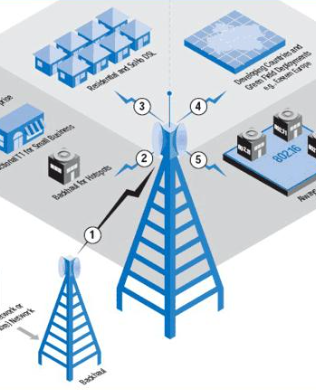 |
Wi-Max (Worldwide
Interoperability for Microwave Access ):
A wireless technology based on the IEEE 802.16 standard providing
metropolitan area network connectivity for fixed wireless access at
broadband speeds. |
|
Wireless Application Protocol (WAP):
An open standard for communication between handsets and the Internet.
WAP is a wireless communications environment for delivering Web data to
wireless terminals with minimal screen display. An initiative started by
Unwired Planet, Motorola, Nokia and Ericsson to develop a standard for
wireless content delivery on the next generation of mobile
communicators. WAP strips all but graphics for display on small screens,
such as mobile phones. A mini-browser is an integral part of WAP enabled
phones. WAP enabled phones first appeared in |
|
.PNG) |
Wireless Fidelity (WiFi):
WiFi provides wireless connectivity over unlicensed spectrum
(using the IEEE 802.11a or 802.11b standards), generally in the 2.4 and
5 GHz radio bands. Wi-Fi offers local area connectivity to WiFi-enabled
devices(smart phones, computers, etc). |
|
Wireless Internet: A general term for using
wireless services to access the Internet, e-mail and/or the World Wide
Web. |
|
|
Wireless Local Area Network (WLAN):
Using radio frequency (RF) technology, WLANs transmit and receive data
wirelessly in a certain area.
This allows users in a small zone to transmit data and share
resources, such as printers, without physically connecting each computer
with cords or wires. |
|
|
Wireless Local |
.JPG)